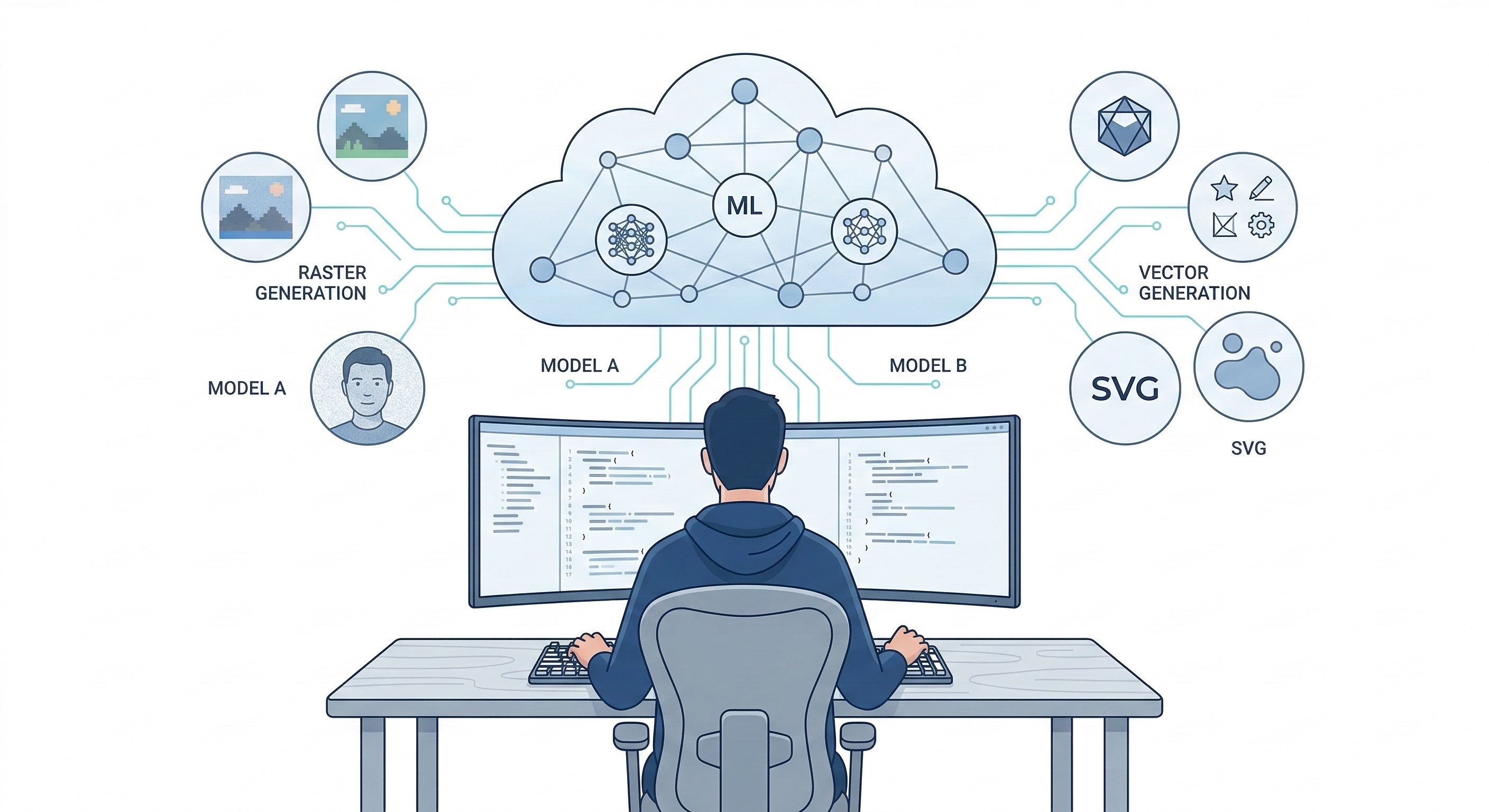
Stop Prompting Pixels, Start Coding Images
As you may know, I’m a software developer by trade and an ultra trail runner at heart. Whether I’m climbing mountain trails or coding a new feature, I’m all about pushing limits and finding the absolute best, most efficient route. In ultra running, that means mastering your mechanics and nutrition, not just following the popular gear hype. In technology, it means something very similar.
The AI Image Generation Hype Cycle
The current narrative is dominated by AI-driven raster image models. Asking a tool to “generate an image” based on a clever prompt is the modern-day hype-cycle. But just like a specific running shoe won’t make you an elite athlete, a clever prompt alone won’t give you a professional, durable design asset. My recent experience fixing a logo taught me a fundamental lesson: we need to stop thinking of images as fixed pixel-grids and start treating them as living, version-controlled code.
From Garbled Paths to Clean Code
I recently requested an SVG logo from a modern AI model. The result was… poor. I got a garbled path and an inefficient structure that was almost impossible to integrate cleanly. But because I had the result as code (an SVG), I didn’t need to re-prompt and hope for a better spin of the wheel. I took the code and refactored it manually:
Layers and Structure: A standard generative raster model gives you pixels; an SVG gives you structural definition. By treating the image as code, I can define the exact placement of curves, points, and horizontal bars.
Fine-tuning Without Corruption: When I need to adjust the width of a specific line in the logo, I can change a single parameter in the code without messing up the geometry of the entire design. With raster images, even a small modification often leads to smudges or pixel-corruption.
Infinite Resolution and Efficiency: Coded vectors are mathematical representations, which means they are infinitely scalable and remain lightweight, crucial for web performance.
The Path Forward
This images-as-code approach is already incredibly useful for logos and icons. While it hasn’t completely superseded raster generation for complex scenes, the path is clear. As model architectures and optimization techniques advance, working through defined layers and vector logic will become the standard.
Stop chasing the perfect prompt. Instead of trying to master a specific generation tool, focus on mastering vector logic, layer composition, and the fundamentals of data representation. This model-agnostic approach ensures you can build assets that are not only correct but efficient, flexible, and future-proof. Master the fundamentals, and your assets will adapt as quickly as the tools emerge.