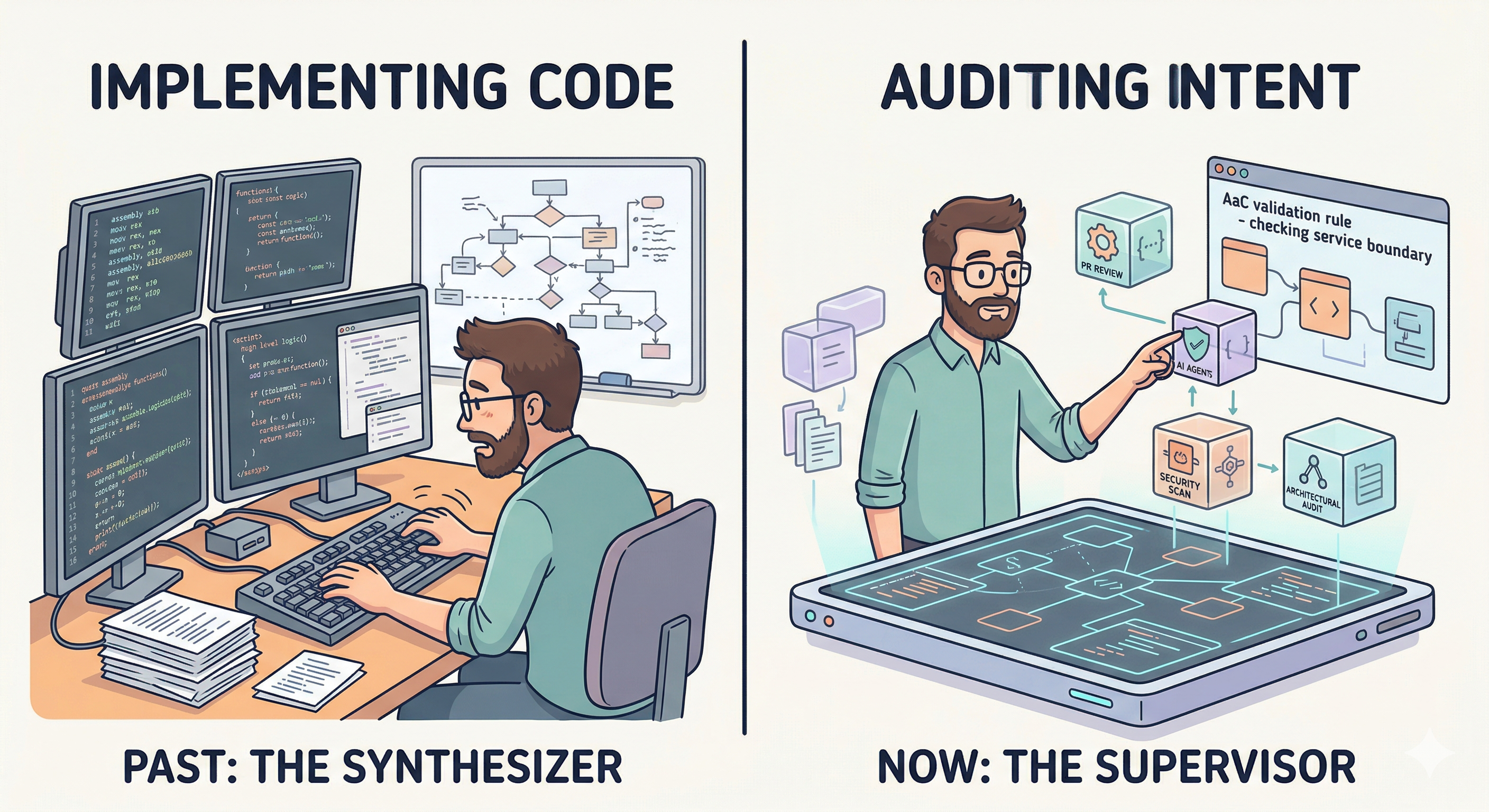
The traditional image of the software engineer—hunched over a mechanical keyboard, meticulously crafting individual lines of logic—is becoming an anachronism. We are witnessing the most significant shift in the SDLC since the move from Assembly to High-Level Languages. We have transitioned from implementing code to auditing intent.
The Friction of Localized Intelligence
Current LLM integrations, while hyper-productive, suffer from “Contextual Myopia.” AI models excel at localized logic but frequently stumble when navigating the “Big Picture.”
Without intervention, this leads to Architectural Drift: implementations that work in isolation but violate the system’s broader ecosystem. To combat this, we are moving beyond simple prompting into a two-tier validation stack:
- Prompt-Level Guardrails: Defining constraints within the “System Message” to guide the AI’s creative process.
- Architecture-as-Code (AaC) Validation: Using libraries to programmatically audit generated code. If an LLM hallucinates a dependency or violates a design pattern, the AaC layer acts as a hard circuit breaker.
# Conceptual AaC Validation Example
def validate_service_boundary(generated_code):
    # Ensure the AI-generated service doesn't bypass the API Gateway
    if "direct_db_connection" in generated_code and not "gateway_context":
        raise ArchitecturalViolationError("Direct DB access detected. Policy requires Gateway mediation.")
The Hybrid Oversight Stack
The modern tech stack for a Senior Lead now involves a dual-layer oversight strategy that filters noise before it reaches the human eye:
- The Tactical Layer (IDE Integration): Tools like Cursor or GitHub Copilot serve as high-speed “Pair Programmers.” This is human-in-the-loop work where the engineer provides real-time supervision for nuanced logic.
- The Strategic Layer (Agentic Workflows): We are deploying autonomous agents via GitHub Actions and multi-agent frameworks (like LangGraph) to act as “Pre-Reviewers.” These agents proactively scan branches for security flaws and architectural inconsistencies. By the time a human opens a Pull Request, the “commodity” errors have already been scrubbed.
AI as the Great Communicator
One of the most overlooked roles of AI in the modern org is its ability to act as a Translation Bridge. Strategic alignment often fails because Stakeholders, Marketing, and Technical teams speak different dialects. The Sovereign Architect now uses AI to synthesize high-level business goals into technical constraints. This ensures that when a stakeholder asks for “scalability,” the AI helps translate that into specific infrastructure guardrails that the engineering team can actually implement without loss of intent.
The New Unit of Work: Strategic Alignment
As models evolve from autocomplete engines to autonomous agents, the “Unit of Work” for the developer is scaling up. In this new paradigm, your value is not measured by lines of code, but by:
- System Constraint Definition: Establishing the guardrails (both via prompts and code) within which the AI must operate.
- Business Goal Evaluation: Ensuring the implementation solves the actual problem, not just the Jira ticket.
- Architectural Integrity: Maintaining the long-term vision against the entropy of AI-generated sprawl.
The code is now a commodity. The architecture is the product.