I recently came across a few videos with the “Agents are Dead” hook. One of them, by Sharbel A., attributes the idea to Anthropic engineers and sums it up near the end: “you don’t need more agents anymore. You need one good agent and a shelf of skills” (15:10).
The idea comes from the talk Don’t Build Agents, Build Skills Instead, by Barry Zhang and Mahesh Murag from Anthropic. The argument is that today’s LLMs are capable enough to decide which skill to use with Agent Skills, so instead of building an agent for each case, all you need is one general agent and “a library of hundreds or thousands of skills that it can decide to pull into context only at runtime” (9:46).
It’s convenient, and I use skills every day, but I don’t agree that it’s a sustainable pattern for everything. It may work for complex operations that need complex or dynamic orchestration, but not for day-to-day operations, especially not at an SME, where keeping AI costs under control is critical. That rests on two assumptions.
1. You need a big brain to pick the right skill
A big brain is what it takes to pick the skill that actually solves the problem, or to make up for it when it picks wrong. And the bigger the library gets, the harder that choice becomes.
In an October study, agents loaded 73.6% of the right skills when no other skills were installed; with 1,000 irrelevant skills in the library, that dropped to 27.4%. In the same study, Claude Opus 4.6 also failed to load many skills, but it compensated and solved almost as many tasks (62.2% vs. 64.9%). A smaller model tends to fail more often at picking the skill, as another study with Haiku and Sonnet suggests, and I think when it fails, it’s more likely to make the wrong call in a very open-ended context.
The speakers themselves admit there’s still a need for “better tooling” so agents load skills “at the right time and for the right task” (10:56).
The model that makes up for the mistakes is the expensive one, and I don’t want to pay for it on every run.
2. Token spend gets out of hand
I’ve written before that the expensive part of an agent is attention. But when an operation runs every day through an API, tokens show up on the bill too.
Large corporations have big budgets and can afford to “burn” tokens. SMEs need tighter control over spending. And the price gap is huge: according to Anthropic’s pricing page (November 25, 2026), Claude Opus 5.5 costs 40 times more per token than Claude Haiku 5.5, for prompts up to 100,000 tokens.
On top of that, with a general agent you pay for the library on every call. According to Anthropic’s documentation, each skill’s name and description take about 100 tokens that are always in context: with 1,000 skills, that’s already around 100,000 tokens. And in my experience, the agent usually doesn’t read just one skill but several, each under 5,000 tokens, and it has to read them again if it decides the skill it picked wasn’t the right one in a more open-ended context.
My proposal: a hybrid approach
Maybe one general agent with lots of skills works well for research and development, where there’s no defined procedure. Building specialized agents still makes sense where the workflow is already defined.
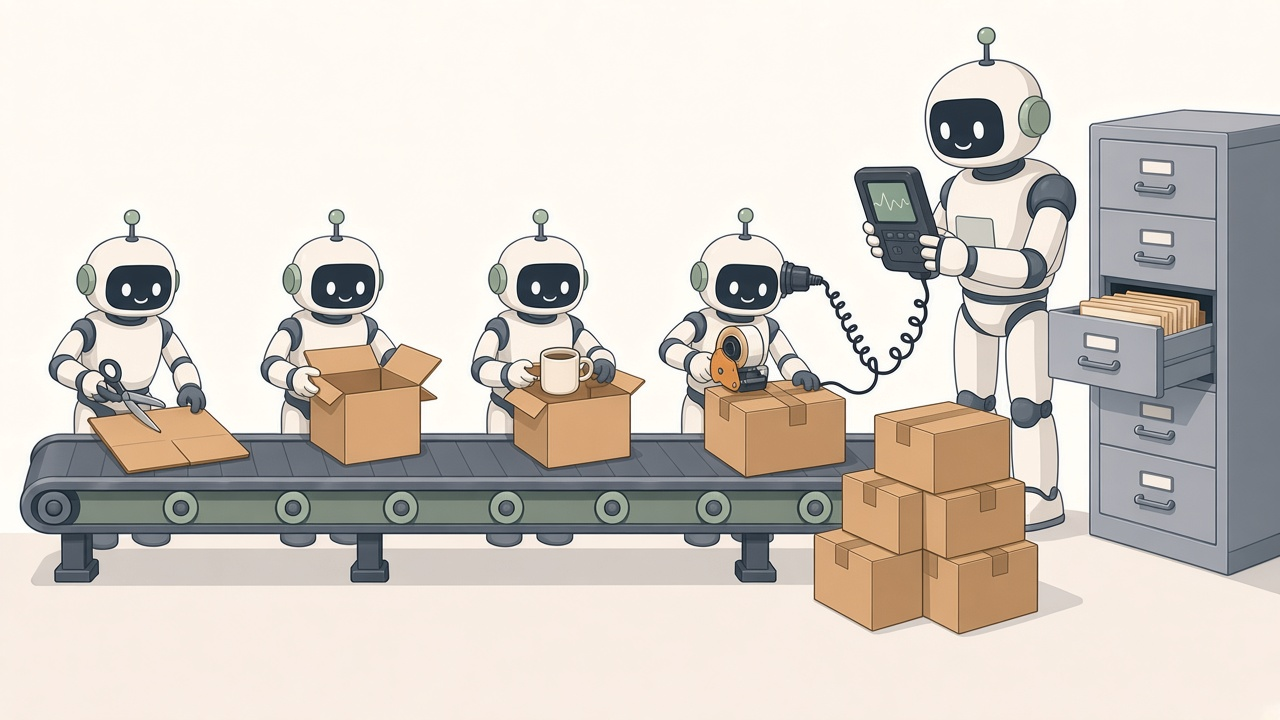
I think the best approach is a hybrid one, like an assembly line: specialized agents with a fixed route, very few tools, and small, cheap models for repetitive operations. Plus the option to escalate to an agent with a frontier model and a bigger skill library when something falls outside the norm.
In Building effective agents, Anthropic itself gives this routing example: “Routing easy/common questions to smaller, cost-efficient models like Claude Haiku 4.5 and hard/unusual questions to more capable models like Claude Sonnet 4.5 to optimize for best performance”.
I’m exploring this in agent-fabric, with specialized agents and a router that recommends a route based on how hard the task is. I haven’t measured it yet, so for now it’s a proposal; once I have better metrics, I’ll do a follow-up.
If you already have agents running in your operations: which decisions are you leaving to the model on every run that you could lock in at design time?